
Conceptual status. The relation between entanglement and geometry is mathematically sharp in holographic settings. Extending it directly to our observed universe remains an open problem.
Correlation before distance
Ordinary geometry begins with distance and then asks how physical fields correlate across it. Holographic quantum gravity suggests that, in some theories, the logical order may be partly reversed: patterns of quantum entanglement can encode how a higher-dimensional geometry is connected.
For a bipartite pure state
the reduced state of subsystem is
and its von Neumann entropy is
This quantity measures entanglement when the global state is pure.
When entropy acquires an area
In an appropriate holographic theory, the Ryu-Takayanagi relation connects boundary entropy to the area of an extremal bulk surface:
The equation does not say that every entangled pair creates a literal tunnel. It says that, within the duality, an information-theoretic quantity and a geometric quantity are two descriptions of the same structure.
If entanglement between complementary sectors is gradually removed, the associated bulk connection can become increasingly narrow. This motivates the idea that connected geometry may be sustained by quantum correlations.
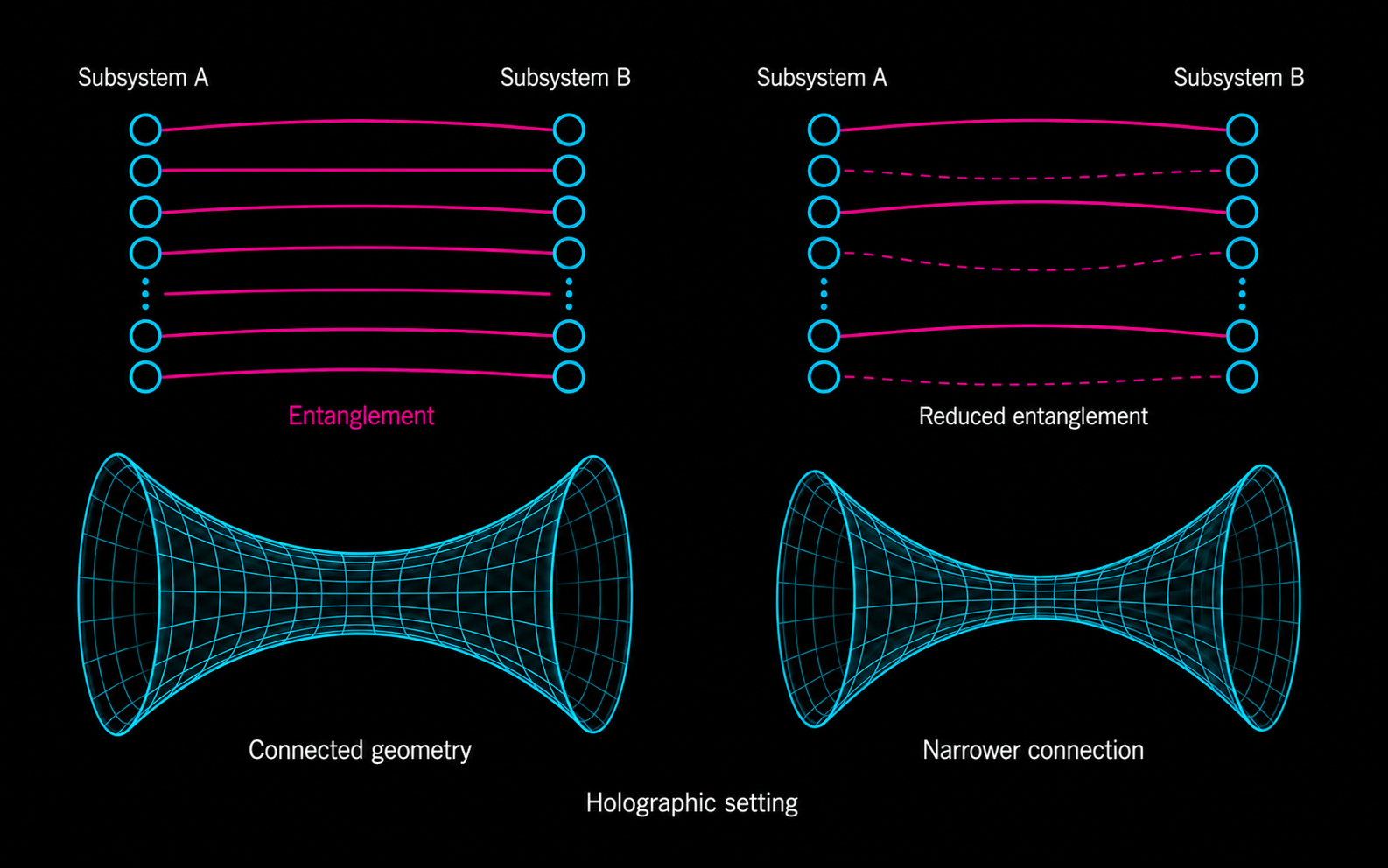
In a holographic setting, stronger entanglement is associated with a wider connected bulk geometry, while reduced entanglement narrows the connection. The diagram expresses the dual relation, not a literal laboratory wormhole.
Why this matters for quantum information
The lesson is deeper than a visual analogy. A quantum state is not merely placed on a pre-existing geometry; the organization of its correlations may help determine which semiclassical geometry is available at all.
Tensor networks make this intuition computational: local tensors encode maps between degrees of freedom, while network connectivity approximates a notion of distance. Yet a tensor network is a model of the encoding, not proof that physical space is literally made of graphical edges.
The boundary of the claim
Three distinctions must remain visible:
- Holographic duality is best understood in special spacetimes, not directly in the observed cosmological geometry.
- Entanglement entropy is not ordinary thermodynamic ignorance.
- An area law is evidence of structured correlations, not by itself a complete derivation of Einstein dynamics.
The research question is whether gravitational field equations can emerge as consistency conditions on quantum information. That is a stronger and testable statement compared with the slogan “spacetime is entanglement.”
Primary starting points
- Mark Van Raamsdonk, Building up spacetime with quantum entanglement.
- Shinsei Ryu and Tadashi Takayanagi, Holographic derivation of entanglement entropy.
The high-value idea is precise: geometry and information need not be independent layers of description, but the domain in which that equivalence holds must always be stated.