
Research status. This note separates established general relativity from a personal hypothesis. Gravitational-wave memory is established; a stable, localized defect able to replace a dark-matter halo is not.
The question hidden inside the hypothesis
A black-hole merger is not merely a collision of objects inside space. It is a nonlinear evolution of spacetime geometry itself. This motivates a precise question: after the remnant has rung down and the radiation has escaped, could some non-radiative geometric degree of freedom remain locally stored?
Einstein's field equation is
Outside matter, setting does not force the full Riemann tensor to vanish. Vacuum can carry curvature. But standard general relativity also predicts that an isolated binary merger radiates its distortions and settles toward a Kerr remnant. A persistent halo-like residue therefore requires more than the statement that vacuum may be curved.
Memory is real, but it is not yet a halo
For nearby freely falling test particles with separation , curvature changes their relative acceleration through geodesic deviation:
A burst of gravitational radiation can leave a permanent relative displacement. This is gravitational-wave memory. The difficult step is to show that a residual field also supplies the stationary radial potential required by orbital dynamics.
For approximately circular motion,
Flat rotation curves require to approach a constant, hence an effective large-radius potential behaving approximately as
Ordinary localized mass does not naturally produce this logarithmic asymptotic form in three spatial dimensions.
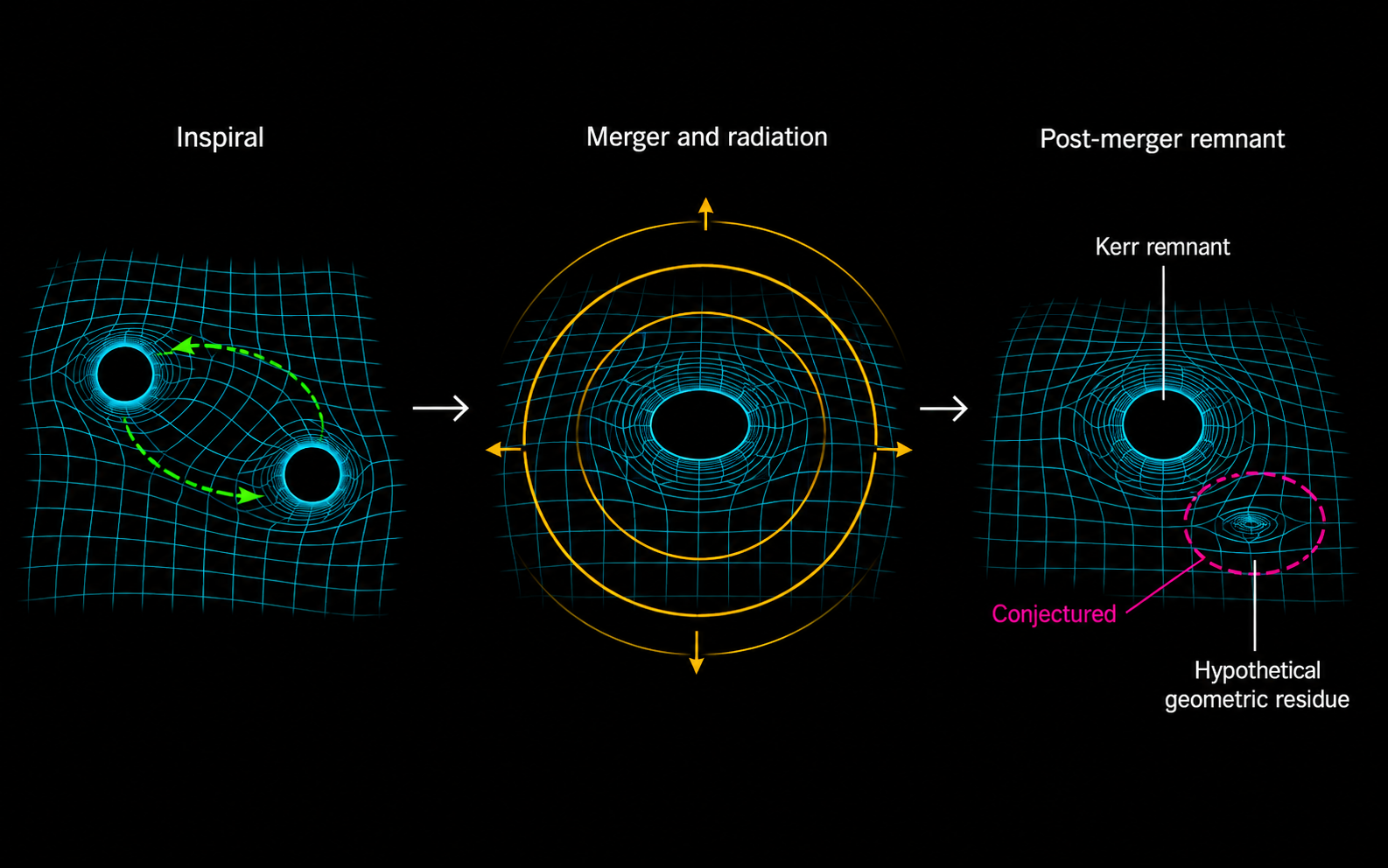
From inspiral to ringdown: outgoing gravitational radiation is separated from the hypothetical localized residue. The final structure is explicitly conjectural and is not a standard prediction of general relativity.
What a viable geometric residue would require
A disciplined extension can be represented schematically as
The tensor cannot be inserted merely to fit a curve. It must follow from a covariant action or from well-defined topological data, obey the Bianchi consistency condition
and remain dynamically stable. The same geometry must predict both massive-particle orbits and light deflection. Otherwise it would explain rotation curves while failing gravitational lensing.
A falsifiable research programme
The hypothesis becomes scientific when it specifies: the geometric variable that stores memory; the production mechanism during merger; its decay or conservation law; the weak-field metric; and one observation that differs from a particle-dark-matter halo.
A first calculation should compare the effective potential, lensing convergence and time evolution generated by one residue with those of a standard halo. A cosmological population can be considered only after the single-defect solution is mathematically controlled.
Primary starting points
- Marc Favata, Gravitational-wave memory revisited.
- Adel A. Rahman and Robert M. Wald, Black Hole Memory.
- John L. Friedman, Kristin Schleich and Donald M. Witt, Topological Censorship.
The strongest present conclusion is therefore conditional: extreme mergers provide a physically motivated place to search for geometric memory, but standard gravitational memory is not by itself evidence for a persistent dark halo.