
Conceptual status. Inverse-problem theory is established mathematics. Every reconstruction nevertheless depends on a forward model, noise assumptions and an explicit account of non-uniqueness.
The forward problem is the easy direction
A measurement system can often be represented as
where is the hidden physical state, is the forward operator, is observed data and is noise. Predicting from a known is the forward problem. Recovering from is the inverse problem.
The inverse may fail to exist, fail to be unique or amplify tiny measurement errors. These are not implementation inconveniences; they determine what can be known from the experiment.
Why direct inversion becomes unstable
For a singular-value decomposition
formal inversion divides each measured component by a singular value. Small magnify noise:
When approaches zero, an apparently precise reconstruction may be dominated by error.
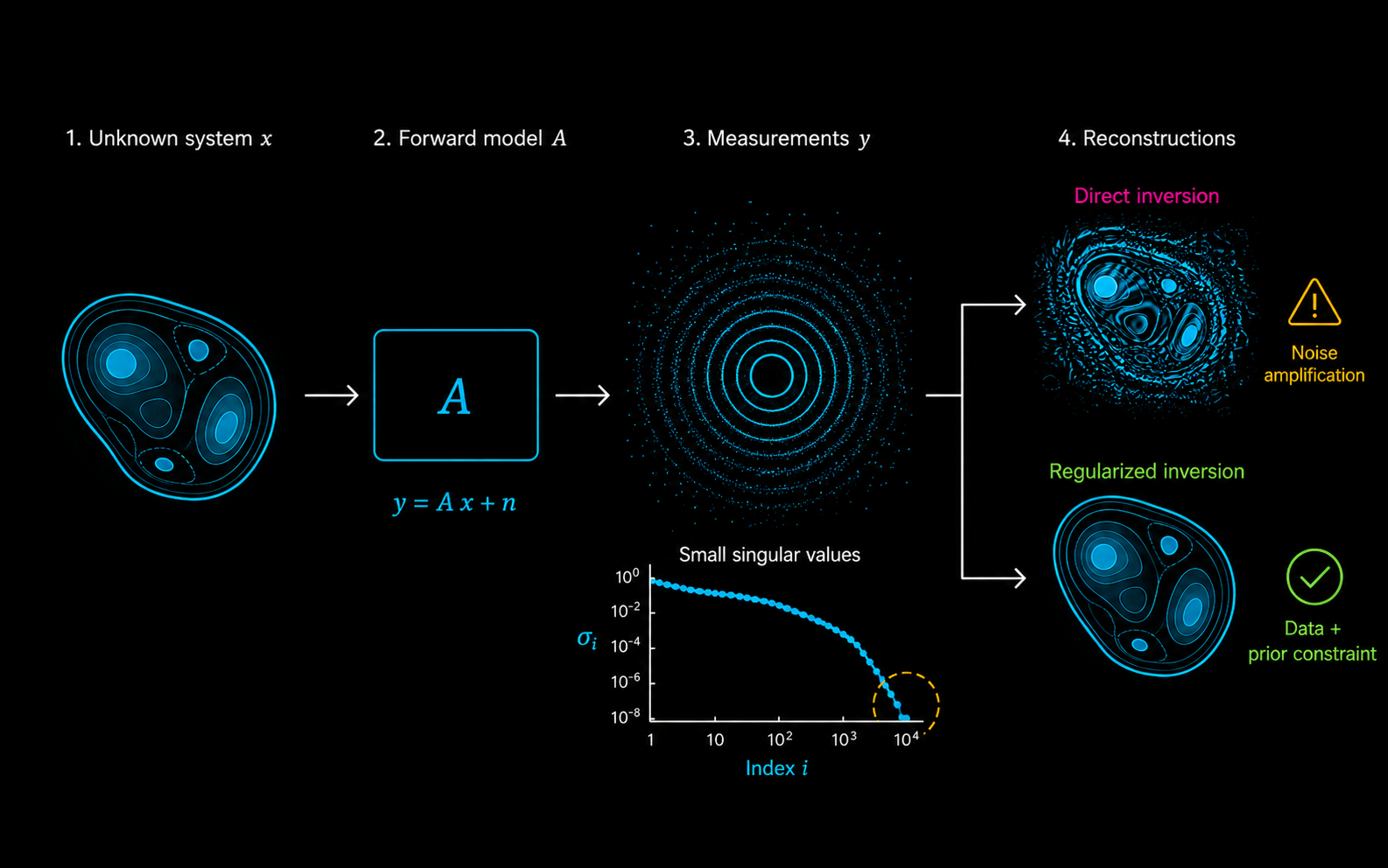
Small singular values amplify measurement noise during direct inversion. Regularization sacrifices exact inversion to obtain a stable reconstruction constrained jointly by data and prior structure.
Regularization makes assumptions visible
Tikhonov regularization replaces unstable inversion with
The first term demands agreement with measurements. The second encodes a preference such as smoothness or bounded energy. The parameter decides how strongly prior structure competes with data.
Regularization does not recover information that was never measured. It selects a stable solution among possibilities by stating which solutions are considered plausible.
One mathematical language, many instruments
Radar imaging, computed tomography, seismic inversion and astronomical lens reconstruction differ physically but share this architecture. Each requires a forward model, an observability analysis, uncertainty propagation and validation against independent data.
This is why scientific computing is more than numerical output. Its central responsibility is to separate what the data determine from what the model assumes.
A path toward a complete essay
A longer treatment can derive the radar or tomography operator, compare regularizers, introduce Bayesian inversion and show how resolution kernels expose the information actually recoverable from finite measurements.
The central lesson is durable: a reconstruction becomes scientific only when its ambiguity is quantified alongside its visual plausibility.