
Conceptual status. Spectral geometry rigorously relates differential operators to geometric invariants. A spectrum contains remarkable information, but it does not uniquely determine every possible shape.
Turning shape into frequencies
On a Riemannian manifold, the Laplace-Beltrami operator generalizes the ordinary Laplacian. Its eigenvalue problem is
The eigenvalues determine the natural frequencies of diffusion and wave phenomena. The inverse question is seductive: if all frequencies are known, is the geometry known?
The heat trace as a geometric fingerprint
The heat equation
has spectral evolution
Taking the trace gives
For small , the asymptotic expansion of contains geometric invariants. Its leading coefficient determines volume; later coefficients encode boundary and curvature information. Frequencies therefore contain measurable traces of geometry.
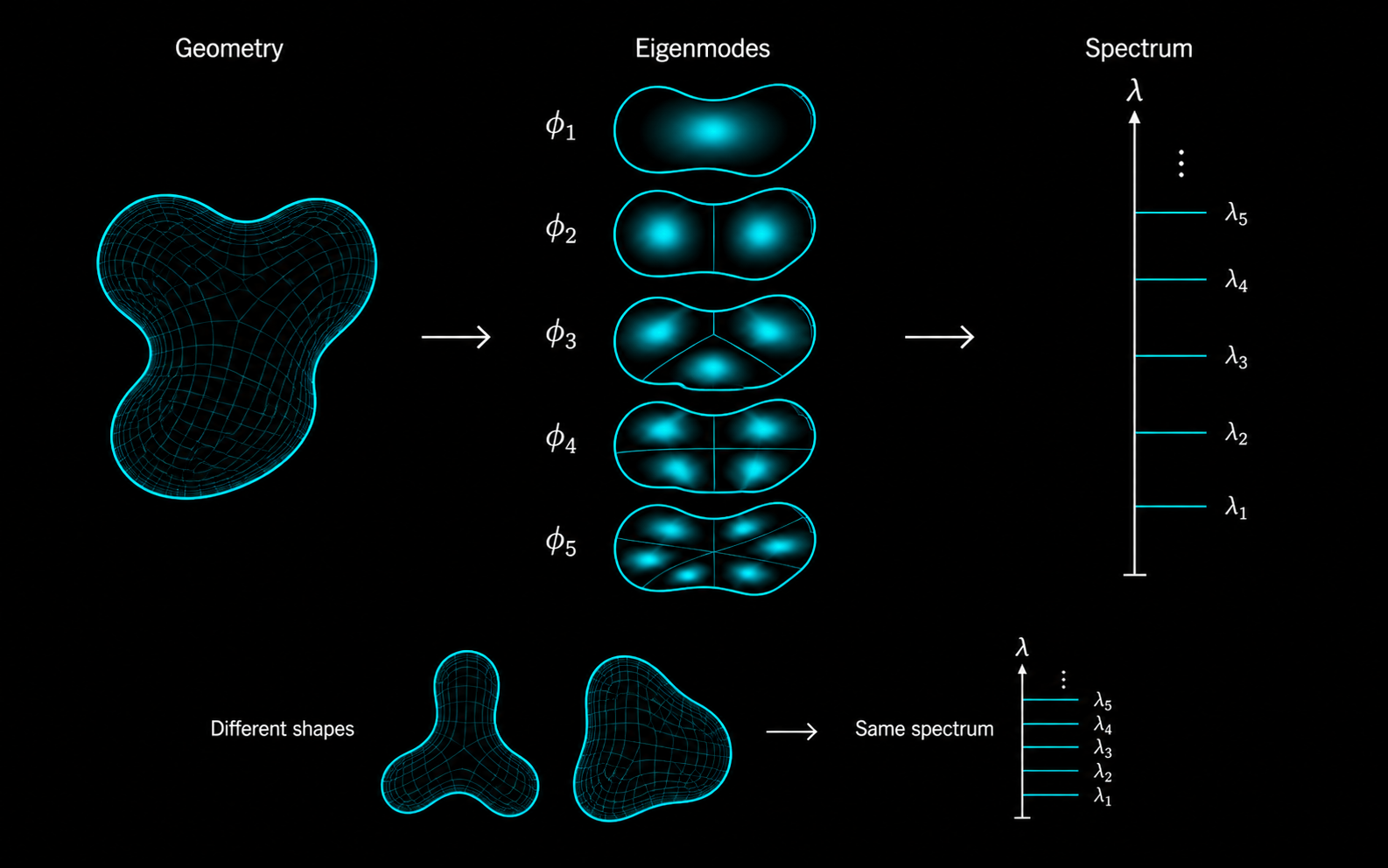
A geometry determines eigenmodes and a discrete spectrum, yet the inverse map need not be unique: distinct geometries can share the same spectral data.
Why the reconstruction is not automatic
Distinct spaces can be isospectral: they possess the same Laplacian spectrum without being isometric. One cannot always “hear” the complete shape. The spectrum is a powerful fingerprint, but not necessarily a unique identifier.
This apparent limitation is scientifically productive. It asks which additional data remove the ambiguity: boundary measurements, several operators, eigenfunctions rather than eigenvalues alone, or controlled perturbations of the geometry.
From mathematics to physics
Quantum fields on curved backgrounds inherit mode spectra from geometry. Conversely, observed resonances may constrain an inaccessible structure. The same logic appears in cavity modes, molecular spectroscopy, helioseismology and gravitational-wave ringdown.
The responsible claim is not that every geometry can be reconstructed from frequencies. It is that operator spectra provide an invariant channel through which hidden geometry becomes experimentally legible.
Primary starting point
- Mark Kac, Can One Hear the Shape of a Drum?.
Spectral geometry is compelling because it converts an ontological question, “what is the shape?”, into an inverse problem built from quantities that an experiment can actually measure.