
Research status. This note uses geometry as a precise mathematical interpretation of representation relationships, not as a claim that a transformer contains a literal physical space.
Attention begins with a bilinear comparison
For an input representation matrix , a transformer constructs
and computes scaled dot-product attention:
The matrix contains pairwise, learned compatibility scores. Unlike a fixed Euclidean distance, those comparisons depend on the trained projections and on the role assigned to each token as query or key.
A data-dependent relational geometry
If vectors are normalized, a dot product is related to angular similarity:
But attention is generally asymmetric because query and key projections differ. It is therefore safer to call the score matrix a learned relational geometry rather than a metric: it need not satisfy symmetry, positivity or the triangle inequality.
The softmax converts scores into row-wise weights
so each output vector becomes a context-dependent mixture
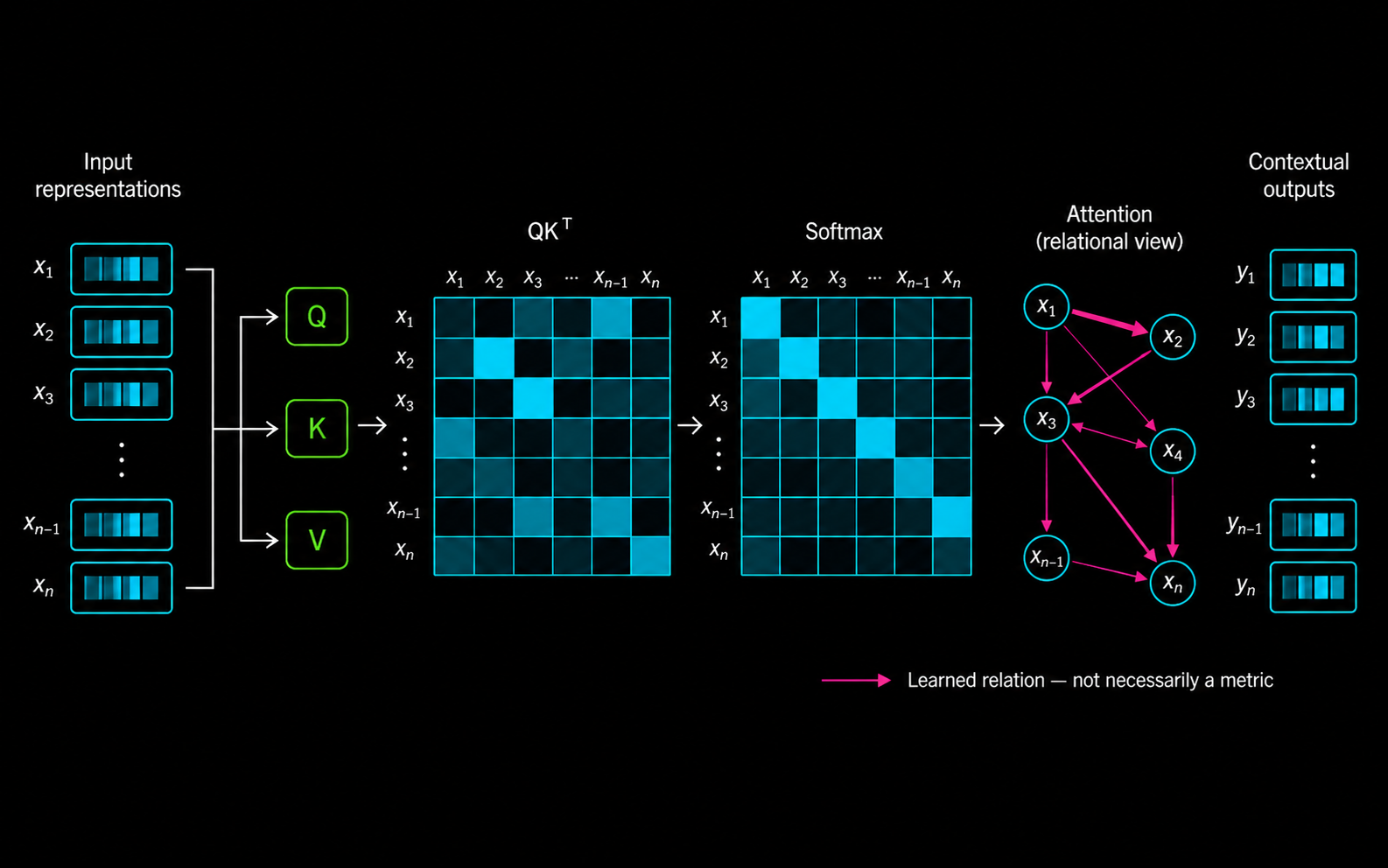
Scaled query-key comparisons become normalized attention weights and then contextual mixtures of value vectors. The resulting relation is learned and directional, so it is not necessarily a mathematical metric.
What is actually learned
Different heads can construct different relational structures over the same sequence. One may emphasize syntax, another positional regularity, and another long-range identity. The model does not discover one universal semantic map; it learns multiple operators useful for its objective.
This viewpoint also clarifies why attention weights alone are not a complete explanation. Values, residual streams, nonlinear layers and later transformations determine how the weighted relation affects the computation.
A productive research question
The rigorous extension is to study which geometric properties emerge in attention operators: effective rank, anisotropy, spectral gaps, curvature-like quantities on induced graphs and stability under perturbation. These can be measured rather than inferred from visualization alone.
Primary starting point
- Ashish Vaswani et al., Attention Is All You Need.
The useful thesis is limited but strong: attention repeatedly constructs task-dependent relational operators, and geometric language becomes valuable when its mathematical conditions are stated rather than merely suggested.