
Conceptual status. Anyons and topological quantum computation are established theoretical frameworks with active experimental programmes. Topological protection reduces sensitivity to local errors; it does not make a device immune to all noise.
Beyond the boson-fermion alternative
In three spatial dimensions, exchanging identical particles leads to bosonic or fermionic statistics. In two dimensions, particle worldlines can braid without being continuously reducible to simple permutations. The relevant structure is the braid group , generated by exchanges satisfying
and, for distant exchanges,
An anyonic system assigns unitary operators to these braids.
Information in the global path
For Abelian anyons, exchanging two excitations may multiply the state by a phase:
For non-Abelian anyons, braiding acts on a degenerate state space:
Different braid orders can produce noncommuting transformations. The operation depends on the topological class of the worldlines rather than every local deformation of the path.
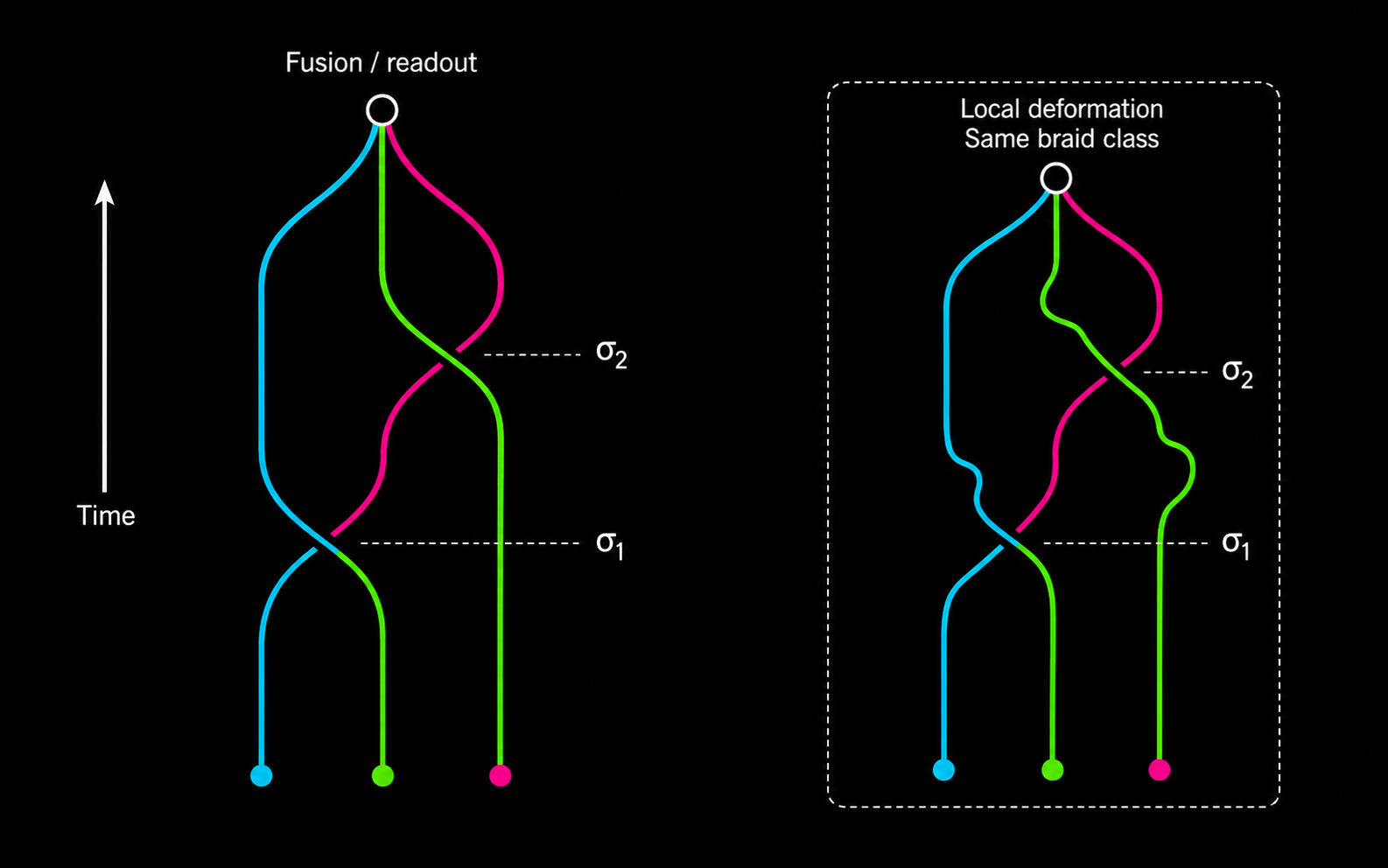
The worldlines encode successive exchanges as time advances upward. Smooth local deformations change the drawing but preserve the braid class and therefore the associated topological operation.
Why topology can protect a qubit
Local noise acts in a bounded region, while logical information can be encoded in a global feature such as a noncontractible loop. In the toric-code model, the Hamiltonian takes the form
where star and plaquette operators enforce compatible local constraints. Logical operators correspond to extended strings that wrap nontrivial cycles. A small local perturbation cannot easily reproduce the complete logical operation.
This is the core of topological robustness: information is distributed nonlocally. It is not stored in one invulnerable particle.
What protection does not guarantee
Thermal excitations, imperfect initialization, uncontrolled anyons, measurement errors and finite-size effects remain physical. A topologically correct braid can still be compromised if unintended excitations participate in it. Fault tolerance is therefore a quantitative threshold problem, not a magical consequence of drawing intertwined paths.
Primary starting point
- A. Yu. Kitaev, Fault-tolerant quantum computation by anyons.
The conceptual payoff is substantial: topology turns a global equivalence class of paths into a computational resource and connects abstract algebra directly to physical error protection.